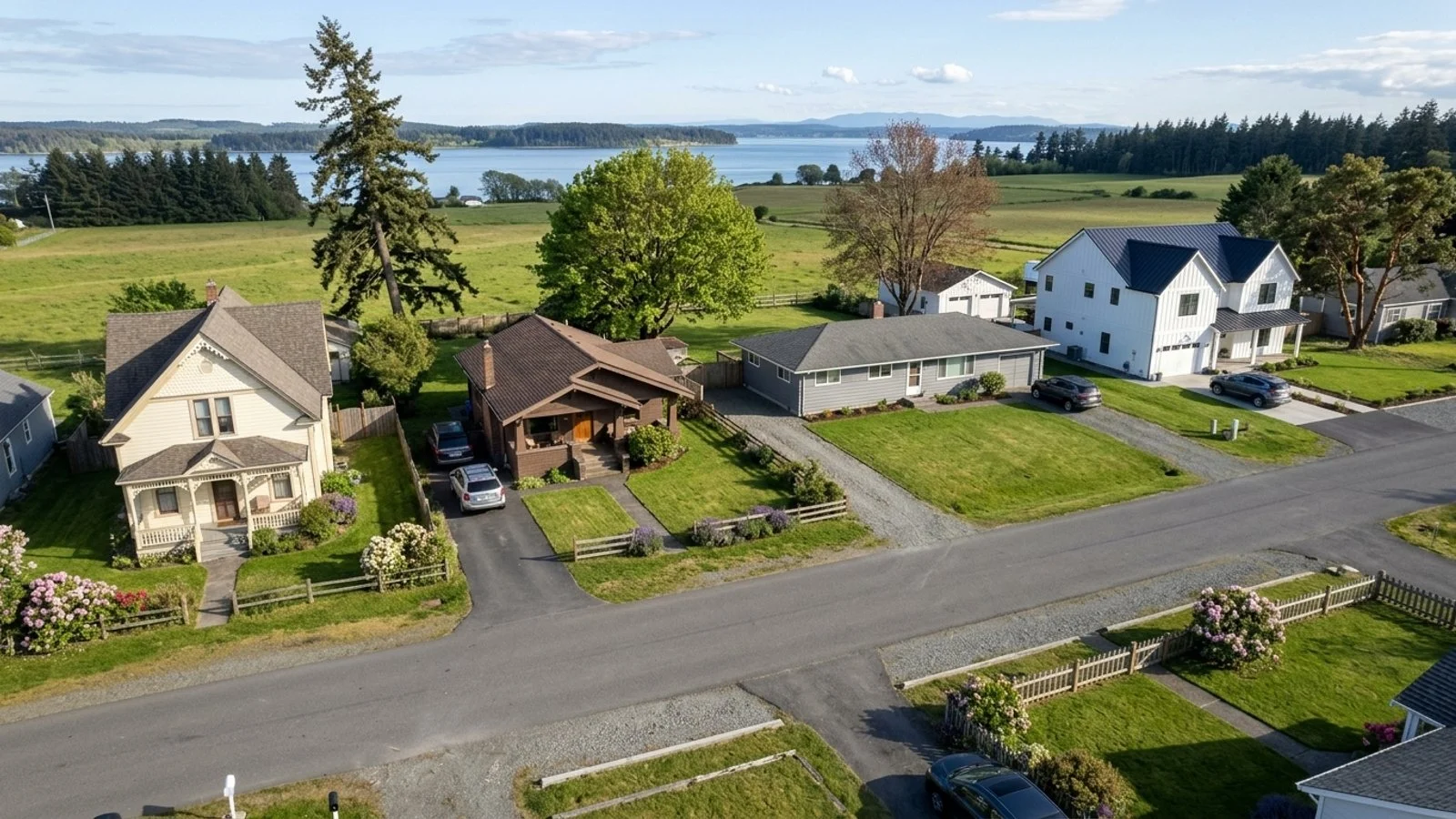
Coupeville offers a distinct set of opportunities and constraints for buyers looking at investment property. Situated on Whidbey Island, the town draws visitors to its historic waterfront and houses local workers, but available inventory stays consistently tight.
Making the math work on a rental or a flip means looking closely at recent sales and local regulations. A property's return depends on the price you negotiate and the specific town and county rules tied to that address.
Key takeaway
Coupeville can work for a rental investment if you buy on price rather than betting on appreciation. The median sale price is down from a year ago, though that rests on just 8 sales in 90 days, so treat it as a signal you can negotiate rather than a confirmed trend. A long-term rental is the simpler route. A short-term rental can earn more but must clear town, county, and state rules, plus a Navy jet-noise check, before you make an offer.
Who this guide is for
You're weighing whether a Coupeville home can pay its way as a rental or a resale project and need the numbers and local rules before you write an offer.
Market conditions for Coupeville real estate investors
Your edge here as an investor is negotiation, not appreciation. Only 8 homes sold in the 90 days ending September 30, 2026, so the year-over-year drop in the median is too thin to read as a trend. One or two unusually large or small sales can move a median built on 8 transactions. That drop is a negotiating signal, not proof that values are falling across the board.
With 4.8 months of supply and homes closing at 97% of list, you're not bidding against a crowd on most listings. That gives you room to make an offer that fits your rent math.
The deal still has to pencil on verified rent and clear local rules: Washington's rent-increase cap, short-term rental registration, historic design review, and Navy jet noise. To understand the broader trajectory of home values, review Coupeville housing market trends. Run your numbers with a CPA or lender.
Rental and renovation strategies in Coupeville
How you operate the property dictates which rules apply and how much day-to-day effort the investment requires. Investors in Coupeville generally choose between signing annual leases, managing nightly visitors, or updating homes for resale. Each approach carries a different balance of upfront work and long-term income potential.
Long-term rentals
A traditional annual lease is the lowest-effort strategy. To estimate potential income, look at the HUD Fair Market Rent for Island County or the U.S. Census median gross rent for Coupeville. A Fair Market Rent is a voucher payment standard rather than a market quote, and the Census figure carries a small-town margin of error, so set these against your actual costs. The local job market will also help you gauge year-round housing demand.
Washington now caps how much most landlords can raise rent each year. You can't price your way out of a thin margin later, because the rent you can get at purchase largely sets your return for years. Washington's landlord-tenant law adds notice and repair obligations to budget for as well.
Short-term and vacation rentals
Nightly rentals offer a higher-income, higher-effort alternative. Coupeville draws visitors to the historic waterfront, Penn Cove, and Ebey's Landing, giving owners a steady stream of guests looking for things to do in Coupeville. Operating a nightly rental stacks three layers of rules: the Town of Coupeville for in-town properties, Island County for properties outside town, and Washington's Short-Term Rental Regulation Act, which requires liability insurance and safety information for guests. Lodging tax applies to gross income.
Demand is seasonal, and nothing in the market data measures nightly rates or occupancy. Confirm whether the town or county permits a short-term rental at that specific address before you count on that income. Ask the Town of Coupeville or Island County Planning whether the parcel can be used that way.
Buying to renovate and resell
The near-balanced market helps buyers hunting for a renovation project. This is where targeting listings that have sat matters most, because your margin is made at purchase. Focusing on upgrades that increase home value in Coupeville helps your renovation budget translate into a higher exit price.
A thin market cuts both ways. With so few sales, your exit sale has limited comparable sales to support the price. Historic review can also slow exterior work and raise its cost, so factor in that timeline before you commit to a project.
Condos and attached homes as rentals
Condos and attached homes can reduce maintenance work, but they add a homeowners association whose rules govern renting. No separate condo figures are available for Coupeville because there were too few sales recently, so evaluate these units individually.
The HOA, not you, decides how and whether you can rent. Before you write an offer, ask for current dues, any rental cap or minimum lease term, any short-term rental ban, and the most recent reserve study.
Costs of buying an investment property in Coupeville
With a median sale price of $560,013 (based on 8 sales, All homes, 90 days ending 2026-09-30), a 25% down payment, which is a common requirement for investment loans, comes to roughly $140,003 and the loan to $420,010. You then add annual property tax at the Island County levy rate, plus insurance and upkeep from your own quotes. Comparing that monthly total with the rent benchmarks shows whether the property covers itself. Since rates fluctuate, check current mortgage rates for an accurate estimate.
Down payment and financing
Loans for non-owner-occupied homes usually require a larger down payment and carry a higher rate than owner-occupied loans. Owner-occupant down payment assistance programs generally don't apply to an investment purchase. Get an investment-property quote, not an owner-occupied one, so you're working with accurate figures.
Investment loan terms vary by lender and by your finances. Ask your lender for the minimum down payment, the rate, and any reserve requirement specifically for a non-owner-occupied property.
Property tax
Property taxes add a significant ongoing cost to your monthly budget. The most recent official per-fund rates from 2024-2025 included a Town of Coupeville Regular levy rate of 0.8426414490 per $1,000, plus port levies. The Assessor applies the statutory maximum rate of $1.50 per $1,000 assessed value for certain non-voted levies unless voters approve a lid lift.
Your bill follows the assessor's value, not your purchase price, and levy rates change yearly. Look up the parcel's current assessed value and last tax bill on the Island County Assessor and Treasurer sites to confirm the exact amount.
Closing costs
Buyer closing costs cover title, escrow, and lender fees and vary by loan type and purchase price. They come out of cash on top of the down payment, which raises the total you'll need to bring to closing.
Insurance, utilities and upkeep
Landlord insurance differs from a standard homeowner policy, and utilities and water providers vary by property. Older homes in a historic town often require more upkeep than newer construction. These are the costs most often underestimated, and none of them appear in the market data. Get a landlord or short-term-rental insurance quote and the past 12 months of utility bills for the address before you finalize your numbers.
Local checks to clear before buying in Coupeville
Coupeville has specific local regulations and environmental factors that can change a property's rent potential, resale value, or renovation cost. Skipping these checks can leave you with a property that can't be used the way you intended.
Before making an offer, verify noise levels, historic district boundaries, utility types, and shoreline restrictions. It's also worth reviewing local schools and confirming school assignment with the Coupeville School District boundary lookup, and checking official safety and crime data.
Navy jet noise from Outlying Field Coupeville
Navy jets practice carrier landings at Outlying Field Coupeville. Noise exposure can affect tenant demand and future resale value, and it's a fixed feature of an address. No renovation removes it. Look up the property on the official noise contour map and ask about noise in the seller's disclosure before you offer.
Historic district and Ebey's Landing reserve rules
Coupeville sits inside Ebey's Landing National Historical Reserve, established to protect the area's historical legacy. The Town reviews exterior changes in its historic area through the Historic Preservation Commission, which issues Certificates of Appropriateness for remodels and new construction. These rules reflect the reserve's founding mandate to preserve the cultural character of central Whidbey Island.
Exterior changes can require approval before work starts, which adds time and can rule out less expensive materials. Ask the Town of Coupeville planning office whether the parcel falls under historic review before you budget a renovation.
Water, wells and septic
In-town properties typically connect to the Town water system, while outlying properties often rely on private or shared wells and septic systems. Island County manages wells with seawater intrusion in mind, classifying areas based on water level elevation and chloride concentration data from nearby wells.
A failing septic system or a well with water-quality problems can cost more than any discount you negotiated. Make a septic inspection and a well flow and water-quality test offer contingencies.
Waterfront and bluff properties
Water views carry strong appeal for rentals and resale in many Coupeville neighborhoods, but shoreline and geologic-hazard rules come with them. Island County's Shoreline Master Program compounds marine buffers and shoreline setbacks, and county permit applications require disclosure of clearing or grading within 100 feet of a bluff.
Bluff erosion and setback rules can block additions and raise insurance costs. For bluff-top or waterfront property, request or order a geotechnical report before you buy.
Deciding if a Coupeville property fits your investment plan
Evaluating a property comes down to matching your budget and timeline with the home's specific rules. A few basic questions help narrow your options.
Does the property need to cover its costs from the first month? If so, run the worked example in the costs section against the rent benchmarks before anything else.
Will you rent by the year or by the night? Yearly points to long-term rentals and the rent-cap FAQ below. Nightly points to short-term rentals and the registration FAQ.
Do you plan exterior changes such as an addition, new windows, or new siding? If so, read the historic district rules first. Design review adds time and limits your material choices.
Can your tenants and your eventual buyer live with jet noise? Look the address up as described in the noise section before you rely on any rent or resale figure.
If you want room to negotiate below asking, start with listings that have been on the market well past the 17-day median. Sellers whose homes have sat are the most likely to accept a price that fits your rent math. If you want the simplest rental to run, start with a long-term rental priced against HUD Fair Market Rent for Island County. That sidesteps short-term rental registration and lodging tax entirely.
If you want nightly rental income from Coupeville's visitor traffic, start with properties where town or county code, and any HOA, allow short-term rentals. If you want to renovate without exterior design review, start with properties the Town confirms are outside its historic review area.
For buyers comparing towns, Coupeville vs Oak Harbor offers useful context. You can also view current Coupeville homes for sale. If you need help finding the right match, Kristen Stavros can pull the listings that have sat longest and the recent sales near a specific address.
At a glance
Median sale price: $560,013 (All homes, 90 days ending 2026-09-30; based on 8 sales, so treat with caution)
Change in median sale price from a year earlier: -14.2% (All homes, 90 days ending 2026-09-30; based on 8 sales)
Median price per square foot: $375 (All homes, 90 days ending 2026-09-30; based on 8 sales)
Median days on market: 17 (All homes, 90 days ending 2026-09-30; based on 8 sales)
Sale-to-list ratio: 97% (All homes, 90 days ending 2026-09-30; based on 8 sales)
Share sold above list price: 25%, or 2 of 8 sales (All homes, 90 days ending 2026-09-30)
Months of supply: 4.8 (All homes, 90 days ending 2026-09-30)
Homes for sale: 13 (All homes, 90 days ending 2026-09-30)
Investing in Coupeville real estate FAQs
Does the 1% rule work for rental property in Coupeville?
The 1% rule requires monthly rent to equal at least that share of the purchase price. At that median (based on 8 sales, All homes, 90 days ending 2026-09-30), the target is roughly $5,600 a month. That figure is higher than the HUD FY2026 Fair Market Rents for Island County and the U.S. Census median gross rent for Coupeville, so most properties fall short of this benchmark.
What licenses and taxes apply to a short-term rental in Coupeville?
The Town of Coupeville requires an annual $100 Short-Term Rental license and limits them to commercial zones, though pre-existing ones in residential zones may continue as nonconforming uses. Operators must designate a local contact within 20 road miles and collect lodging and sales tax on gross income. Unincorporated Island County currently has no dedicated countywide ordinance and regulates short-term rentals only through general zoning, so confirm the parcel with the town or county.
Does Washington limit how much a landlord can raise rent?
Yes. Under Washington's rent stabilization law, most residential rent increases are capped at the lesser of 7% plus CPI or 10% in any 12-month period, with the 2026 cap set at 9.683%. Landlords must provide 90 days of written notice. Certain properties, such as new construction under 12 years old, are exempt, so verify whether the specific property is covered.
What county is Coupeville, WA in, and how do you appeal a property assessment?
Coupeville is in Island County. Appeals of an Island County Assessor valuation must be filed with the Island County Board of Equalization. The deadline is the later of July 1 of the current assessment year or within 30 calendar days of the mailing date of the Assessor's Change of Value Notice.
How far is Coupeville, WA from Seattle?
The trip involves both driving and a ferry ride. From Seattle, you drive north on I-5 to the Mukilteo ferry, take the 20-minute crossing to Clinton on Whidbey Island, and then drive approximately 28 miles north on SR-525/SR-20 to Coupeville. Check getting around Coupeville for ferry schedules and details.
Do you need a business license to rent out a home in Coupeville?
Yes. The Washington Department of Revenue requires short-term rental operators to obtain a state business license. Separately, the Town of Coupeville requires its own general business license with a $25 origination or renewal fee for any business operating within town limits, including rentals. Confirm the exact requirements for your property with the Town clerk.