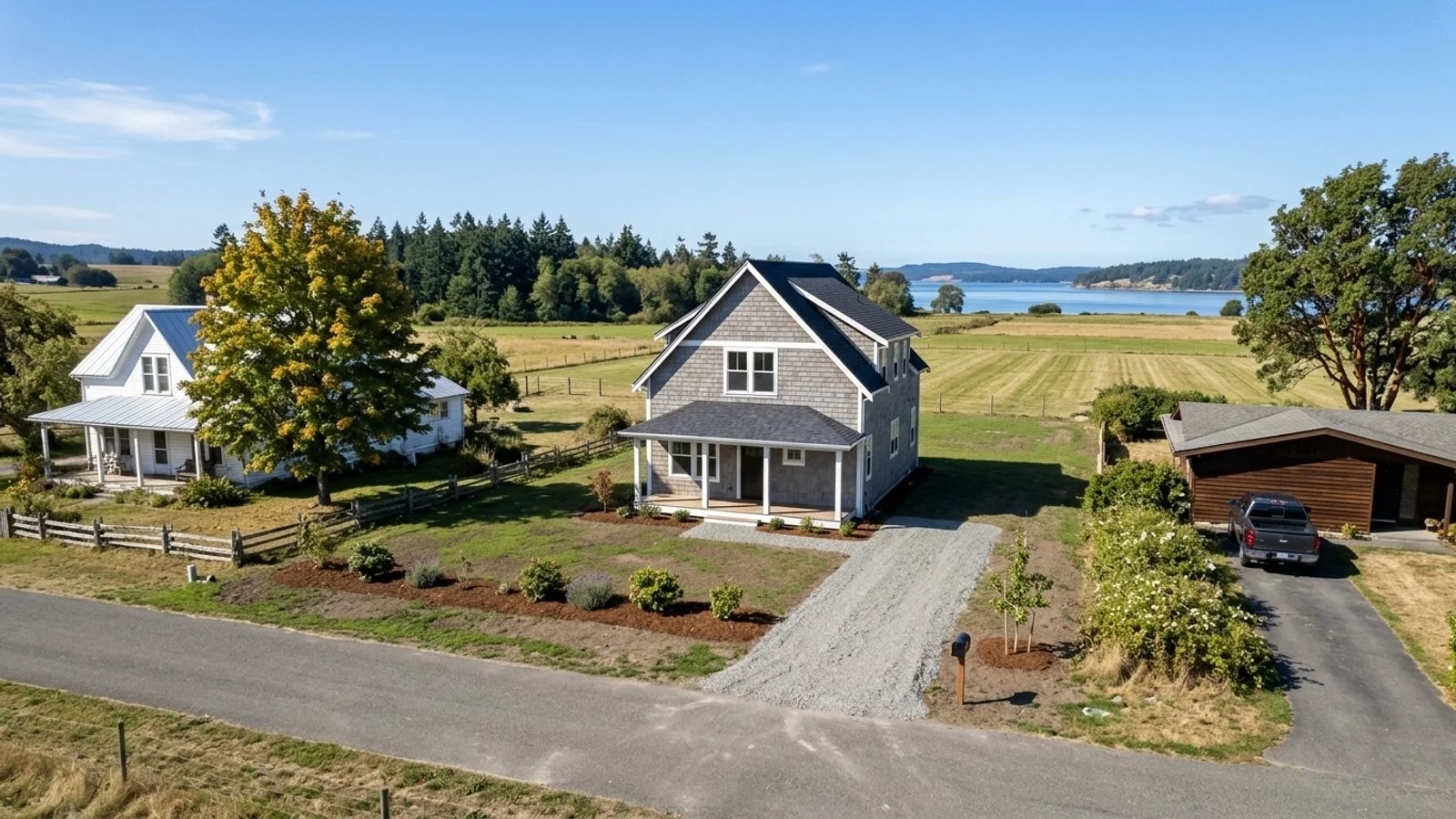
Coupeville sits on central Whidbey Island, where historic farmland meets Penn Cove. Finding the right property here means looking seriously at both existing homes and vacant land, because neither path is obviously simpler.
Building in Coupeville involves strict design rules and limited island resources. You'll need to clear specific water, septic, and permitting hurdles before any foundation gets poured.
Key takeaway
Build in Coupeville only when the resale market can't give you the site or layout you need. Prices dropped sharply over the past year based on a small sample of 8 sales. A standing home with room to negotiate is often the cheaper path. If you do build, first confirm whether your lot falls under the Town of Coupeville or Island County and whether it sits inside Ebey's Landing National Historical Reserve, because that decides your permit office, design rules, and a large part of your cost.
Who this guide is for
You're weighing whether to build a house on land in or near Coupeville or buy one that's already standing, and you need to understand what building involves before you commit money to a lot or a builder.
Should you build or buy a home in Coupeville?
The resale market sets the bar a custom build has to clear. Existing homes sold at a median $375 per square foot in the 90 days ending September 30, 2026, closing at nearly full list price after a sharp year-over-year price drop based on 8 sales. Buyers can review the Coupeville housing market trends to see current local conditions.
Building pays off only when your all-in cost for land, water, septic, permits, and construction lands near that benchmark, or when you need a site or design that the 13 homes currently on the market simply can't offer.
What existing homes cost right now
The median sale price for homes in Coupeville was roughly $560,013 in the 90 days ending September 30, 2026, drawn from just 8 recent sales. One waterfront property or one fixer can swing that number noticeably in either direction. Treat it as a rough marker rather than a firm budget target.
Why falling prices give buyers room
Recent sales closed near full list price. In a softer market like this one, a buyer of an existing home has real room to negotiate on price or repairs. A builder's bid rarely allows for that kind of flexibility. Worth knowing: 25% of recent sales still went over asking, so the best-located homes can still draw competition.
When building is the better answer
With only 13 homes on the market recently, you might not find a specific view lot, a one-level plan, or a large outbuilding. When the inventory genuinely can't offer what you need, building earns its extra risk.
The tradeoffs are real, though. You take on land, permit, and construction risk, and you carry those costs for months before you can move in, while a resale buyer closes in weeks.
When buying an existing home wins
Coupeville recently showed 4.8 months of supply and a median of 17 days on market. A near-balanced market lets you inspect, negotiate, and close on a known price and schedule. If a move-in-ready home this year is the goal, the existing inventory is worth a hard look.
What you give up is brand-new infrastructure. Septic age, roof condition, and drainage become your problem from day one, so the inspection and septic records matter more than the asking price.
How to decide whether to build
Your first question is whether you already own the land or need to buy it. If you're buying, read the sections below on water service, septic systems, and feasibility testing before you make an offer.
Then ask whether any of the homes currently on the market could work with some changes. If yes, compare the benefits of buying an existing home against the build example for a 1,500-square-foot home before you start talking to contractors.
You also need to know whether your lot is inside Coupeville town limits, inside Ebey's Landing Reserve, or both. The answer changes your review process entirely. And you'll need to decide early whether you want to manage subcontractors yourself or hand off the whole job, since that choice affects both your costs and your loan options.
Cost to build a house in Coupeville
Your total cost runs well past the price of the lot. Site preparation, utility connections, design fees, and the physical construction of the house all go on the same invoice.
Every property is different, and those differences matter. A cheap parcel can turn expensive quickly if it requires a complex septic design or a long driveway cut through rough terrain.
Land
The lot price is your entry cost, not your all-in cost. What the lot can support, considering water access, septic capacity, slope, and historical reserve rules, is what determines its real value to you. Bargain parcels are often cheap for a reason: no proven water source, poor soils for septic, or terrain that makes everything else harder.
Water service or a well
Inside town limits, you connect to town water and pay a connection fee. Outside town, Island County requires proof of a potable water source, such as an approved Water Availability Verification form, before it will issue a building permit. You can review local utility providers and monthly costs to estimate ongoing bills. The complication is that seawater intrusion limits new wells in some coastal areas, so a lot without an established water source may not be buildable as planned.
Septic system or town sewer
Most lots outside town sewer require a site evaluation and a septic design approved by Island County Public Health. The county's 2026 fee schedule lists a site registration at $546, a standard system permit at $431, and an alternative system permit at $650. The soil dictates the system type and your final cost. If the site evaluation fails or calls for an engineered system, that cost can jump.
Site prep, driveway and power
Clearing, grading, pouring a driveway, and running power to the house site are easy to underbudget on acreage. Puget Sound Energy provides a margin allowance for new residential service lines, which is $7,880 effective in early 2026, to help offset normal construction costs. Charges above that allowance are billed as a line-extension charge. A long setback from the road means a long driveway and a long power run, both paid before the house goes up.
Design and engineering fees
Plans, a site survey, structural engineering, and possibly a geotechnical report are separate costs from construction. Get written quotes from local professionals to understand these upfront expenses. Once drawings are done, flexibility disappears. If design review or the septic design forces changes later, you pay for revisions.
Permits and impact fees
The Town of Coupeville handles permits within town limits under Title 16 of the town code, with its fee schedule most recently updated in April 2025. Unincorporated areas go through Island County Planning and Community Development. The county raised its planning and building fees by 40% in January 2026, with another 20% increase planned for 2027. Fees are generally based on project valuation, so a larger or more finished home costs more to permit.
Construction cost per square foot
Labor and materials make up the largest line item. Island delivery logistics and a smaller local labor pool can push these costs higher than on the mainland. Get at least two written bids from contractors, and always ask what's excluded. A per-square-foot quote often leaves out site work, septic, the well, and permits.
Build cost compared with buying
At that median, a 1,500-square-foot existing home works out to about $562,500. To compare that against building, add your land cost, water, septic, site prep, design, and permits to the builder's construction quote for a similar size. Don't forget construction-loan interest and rent during the build phase. That benchmark comes from just 8 mostly older homes, while a new build includes new systems, so treat this comparison as a starting point rather than a final verdict.
Building inside Ebey's Landing National Historical Reserve
Ebey's Landing National Historical Reserve covers approximately 17,572 acres on central Whidbey Island. Established in 1978, it encompasses the Town of Coupeville and surrounding farmland near Penn Cove.
The reserve includes a mix of federal, state, county, and private land. Building a home within its borders means adhering to specific historical design guidelines, and that requirement applies whether you realize you're inside the reserve or not.
Where the reserve boundary runs
Much of the land around Coupeville falls inside the reserve. Check your parcel against the official boundary map before purchasing property or starting a design. The reserve is a patchwork of private land, not a fenced park. You can't assume a lot sits outside it just because it looks ordinary.
Design review inside Coupeville town limits
New construction in town goes through a joint design review conducted by the Town of Coupeville and Island County. A Historic Preservation Commission reviews projects and issues Certificates of Appropriateness based on adopted guidelines. The commission includes four representatives from the town, four from the county, and one from the reserve. That review adds a step, and possibly a meeting date, to your timeline before the building permit moves forward.
Design review in unincorporated Island County
Outside town limits but inside the reserve, county design guidelines for the historical area still apply. The same joint commission oversees these applications to ensure they match the historical character of the region.
On open prairie or visible hillsides, guidelines can shape where the house sits on the lot. That required location may not be where the view is best.
What design review can change about your plans
The commission looks at how your proposed home fits into the historical setting, including siting, height, and materials. Ask for the current design guidelines before your first design meeting. Changes requested after plans are finished cost you redesign fees and time, and that's an avoidable expense if you start with the guidelines in hand.
Ways to build a home in Coupeville
You have several paths to get a new house on your land, from a fully custom build to a factory-built modular unit. Each option balances how much control you keep against how much risk you carry.
Your choice also affects financing. Lenders view a licensed general contractor differently than a homeowner managing their own project, and that distinction can determine what loans are available to you.
Hiring a custom builder
One contract, one point of responsibility. Verify the builder's Washington contractor registration and bond through the Department of Labor & Industries before signing anything. If you agree to a cost-plus contract, cost overruns are yours to absorb. Ask for a fixed price, or at least a cap and a written list of allowances.
Modular and prefab homes
Factory construction can shorten the build time and firm up the house price. The site work, foundation, septic, water, and permits still happen locally, at local cost. Delivery onto the island and crane access to your site are real additional expenses. Ask the manufacturer for the delivery route and a site access check before you commit.
Acting as your own general contractor
Managing the project yourself lets you keep control and potentially save the contractor's markup. You'll be responsible for scheduling subcontractors, inspections, and material deliveries. Many construction lenders won't fund owner-builders, or they require extra experience and large cash reserves. Ask a lender about their specific rules before you plan around this path.
Adding an ADU instead of a full house
If you already own a home on a lot that can take a second unit, an accessory dwelling may give you the space at a lower total cost. Under Island County zoning, detached ADUs are allowed in several rural zones, capped at 1,200 square feet of gross floor area. These units require shared access with the primary dwelling and can't be sold separately. An ADU still needs septic and water capacity, and an existing system sized for one house may not cover two.
How to build a house in Coupeville, step by step
The order of operations matters when you're developing raw land. Spending money on house plans before you know whether the soil can support a septic system is a common and costly mistake.
A strict sequence protects your budget. Secure your utility feasibility and financing before you finalize a construction contract.
Step 1: Find out which office permits your lot
Inside town limits, the Town of Coupeville handles permits. Outside town limits, Island County Planning and Community Development issues them. Look up the parcel and ask the office directly to confirm jurisdiction. A Coupeville mailing address doesn't mean the lot is inside town limits, and that wrong assumption sends you to the wrong office and fee schedule.
Step 2: Test water and septic feasibility before you close on land
Write the purchase offer with time to complete a septic site evaluation and confirm a water source. You can review local buyer closing costs to see how land transactions work. Feasibility work costs money even if the lot fails, but it costs far less than owning land you can't build on.
Step 3: Check shoreline, bluff and wetland rules
Penn Cove shoreline, bluffs, and wetlands carry setbacks and possible additional review. Under the Island County Shoreline Master Program, a marine shoreline home in the Rural Conservancy designation requires a 75-foot buffer and a 25-foot setback, yielding a total width of 100 feet. Look up the parcel on the FEMA flood map as well. Setbacks can shrink the buildable area of a lot well below its listed acreage.
Step 4: Line up construction financing
You'll generally choose between a construction-only loan or a construction-to-permanent loan that converts to a standard mortgage once the house is finished. Check current mortgage and construction financing rates to compare your options. Construction loans often require a larger down payment and use draw schedules tied to inspections. Get the lender's exact terms before you commit to a builder.
Step 5: Get bids and sign a contract
Get at least two written bids on the same plans and compare the exclusions and allowances line by line. Confirm the contractor's registration with the state before signing. The lowest bid is often the one with the most items left out.
Step 6: Submit plans and schedule inspections
The process moves from permit application and plan review to design review where it applies. Once approved, you'll have staged inspections from the foundation pour through the final walkthrough. A failed inspection stops work until the issue is corrected, and every pause is paid for in loan interest.
Step 7: Plan for the wait
While you build, you may be paying rent or a current mortgage alongside construction-loan interest. Budget those months as a real cost of the project. Wet-season delays on site work can stretch the schedule, and when the timeline stretches, your carrying costs go with it.
Weather and site conditions to plan for
Coupeville's island geography introduces specific environmental factors that affect your build directly. The weather and the soil influence your structural engineering and site preparation, and understanding them early helps you avoid expensive surprises during framing and foundation work.
Rain shadow and wind exposure
Coupeville sits in the Olympic rain shadow, with an average annual precipitation of 20.22 inches. That's less rain than much of western Washington, but exposed prairie and bluff sites take heavy wind. Island County directs engineers to use specific climatic design criteria for wind and seismic loads. An open, view-facing site can mean stronger framing, better window ratings, and more careful siting than a sheltered lot requires.
Soils, slopes and drainage
Glacial soils, bluff edges, and drainage patterns affect both the foundation design and the septic system. Island County regulates geologically hazardous areas susceptible to erosion or landslides to minimize risks. A required geotechnical report or an engineered foundation is a cost that won't appear in a builder's initial per-square-foot figure.
At a glance
Median sale price: $560,013 (all homes, 90 days ending 2026-09-30, based on 8 sales)
Change in median sale price vs. a year earlier: -14.2% (all homes, 90 days ending 2026-09-30, based on 8 sales)
Median price per square foot: $375 (all homes, 90 days ending 2026-09-30, based on 8 sales)
Median sale-to-list ratio: 97% (all homes, 90 days ending 2026-09-30, based on 8 sales)
Share of homes sold above list price: 25% (all homes, 90 days ending 2026-09-30, based on 8 sales)
Median days on market: 17 (all homes, 90 days ending 2026-09-30, based on 8 sales)
Months of supply: 4.8 (all homes, 90 days ending 2026-09-30)
Homes for sale (inventory): 13 (all homes, 90 days ending 2026-09-30)
Caution: every sales figure above rests on 8 sales, so a single unusual sale can move it noticeably
Building a home in Coupeville FAQs
Does building inside Ebey's Landing Reserve cost more than building outside it?
Yes, in most cases. The joint design review adds time and possibly redesign fees if your plans don't match the historical guidelines. Starting with those guidelines in hand before your first design meeting is the most direct way to limit that extra cost.
Can I legally build my own house in Washington?
Yes. Washington law generally requires anyone constructing a building to register as a contractor, but RCW 18.27.090(12) provides an exemption for owner-builders. You can do the work on your own personal residence as long as you're not building it to sell or lease, though you should confirm whether your lender allows owner-builder projects.
What county is Coupeville in, and does the county issue building permits?
Coupeville is the county seat of Island County. The Town of Coupeville issues building permits for properties inside town limits, operating under Title 16 of the town code. Island County Planning and Community Development issues permits for properties in the unincorporated areas outside town limits.
Can I put a modular or manufactured home on land near Coupeville?
Yes, with some restrictions. Island County zoning rules require mobile or manufactured homes on rural lots smaller than 2.5 acres to be double- or multi-sectioned construction. If your land is inside Ebey's Landing National Historical Reserve, the home will also need to pass a joint design review to ensure it fits the historical character of the area.
How long does it take to get a building permit in Island County?
It varies based on the season and the complexity of your project. Island County doesn't publish a guaranteed review timeline on its official permit pages. Ask the permit counter for current wait times, as septic approval and historical design review can add to the schedule.
Do I need an architect to build a house in Coupeville?
No, not for a standard single-family home. Washington law (RCW 18.08.410) exempts residential buildings of up to four dwelling units from the architect-licensing requirement. You may still need licensed engineers for your septic design, structural framing, or geotechnical reports.