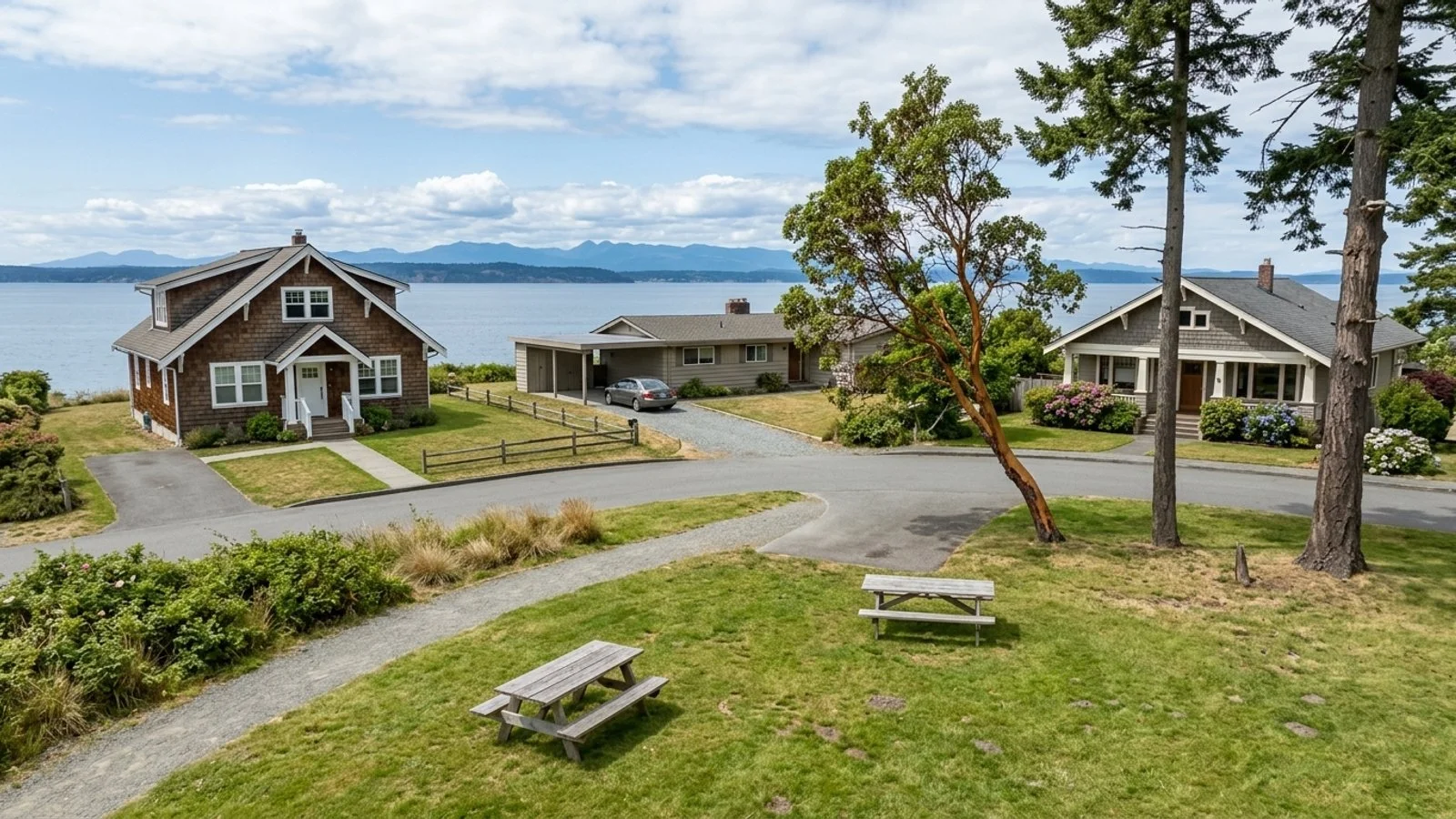
Whidbey Island stretches roughly 35 miles across Island County, sitting between the Puget Sound and the Strait of Juan de Fuca. It's a place of real contrasts - rugged shorelines and dense forests alongside an active naval air station and historic port towns that have been here for generations.
The first thing most people buying a home in Whidbey Island, WA don't fully grasp until they're here: your life on this island is shaped by whether you're in the north or the south. Bridge access in the north, ferry routes in the south. That divide touches everything - your commute, your home price, and what Tuesday morning looks like.
What It Is Like to Live on Whidbey Island, WA
The island isn't one thing. The north runs on Naval Air Station (NAS) Whidbey Island - Oak Harbor is the commercial center, and the economy there reflects it. Head south toward Coupeville, Freeland, and Langley, and the density drops, the commercial activity thins out, and the pace changes noticeably.
Residents build their routines around the water and the weather. Weekends fill up with boating, hiking, and community events. Weekdays often get scheduled backward from the Washington State Ferries timetable. If you've never planned a meeting around a boat, you'll learn quickly.
Who Tends to Move Here
The market draws active-duty military personnel, civilian defense contractors, and remote workers. Oak Harbor sees consistent turnover tied to military deployments and reassignments - that keeps its housing market active in a way that's different from most small towns.
Retirees tend to look at the southern half of the island, drawn by the slower pace and proximity to specialized senior living facilities. Buyers commuting to Seattle cluster near the southern ferry terminals. That's not a coincidence - every extra mile from Clinton means more time in the car before you even get on the boat.
Where Whidbey Island Is Located and How to Get Around
Whidbey Island sits entirely within Island County, WA, positioned just north of the Seattle metropolitan area. The island's long, narrow shape means a drive from the northern tip to the southern ferry terminal can take over an hour, and that's without traffic.
Two ways on and off: the Deception Pass Bridge at the north end, which connects Whidbey to Fidalgo Island and the mainland and handles freight and anyone heading toward Bellingham or Vancouver, B.C. - or the ferry system. Most commuters headed for Seattle use the ferry. Most of the freight that ends up on your grocery store shelves crossed that bridge.
The Mukilteo-Clinton Ferry Route
The Clinton-to-Mukilteo crossing is about 2.6 nautical miles and takes approximately 20 minutes each way. Ferries run roughly every 30 minutes, with up to 30 sailings per day.
Twenty minutes sounds short. It is short. But that's the crossing - you also need to factor in terminal wait times, which expand during summer weekends and holiday peaks. A 20-minute crossing can easily become a 90-minute ordeal in July if you mistime it.
The Cost of Living and Housing Prices
Island County, WA, has a cost of living index of about 121.2 - everyday expenses running roughly 21% higher than the national average. Groceries, utilities, and transportation all carry an island premium. Getting goods across the water costs money, and that cost lands on you.
Housing is where you feel it most. The median home sale price on Whidbey Island is currently around $634,860. That number is supported by steady demand and a hard geographic limit on where new construction can happen.
Local Real Estate Trends
Available homes are currently selling in a median of 18 days on the market. The island holds an inventory of about 341 homes, which works out to roughly 3.7 months of supply. Well-priced listings move, and buyers should expect competition when one comes up.
Geography does most of the work on price variation. North Whidbey areas like Oak Harbor tend to offer lower entry points. South Whidbey communities like Langley and Clinton frequently see median prices exceeding $800,000. Same island, very different numbers.
Local Crime Rates and Public Safety Data
Island County carries a total crime rate of about 37.88 per 1,000 residents, with a violent crime rate of approximately 3.68 per 1,000 residents - which aligns closely with the average for U.S. counties. Law enforcement is split between municipal police departments in the incorporated towns and the Island County Sheriff's Office covering the rural, unincorporated areas. Response times in the more remote sections of the island can vary.
Oak Harbor Crime Statistics
Oak Harbor, the island's largest city, reports a total crime rate of about 990.9 per 100,000 people - roughly 53% below the national average based on FBI data reporting. Because Oak Harbor has the highest concentration of retail and commercial businesses on the island, property crimes account for most of those reports. The presence of NAS Whidbey Island also brings a dedicated military police presence to the areas immediately surrounding the base.
Population and the Local Economy
Island County - which includes both Whidbey and Camano Islands - had an estimated population of 85,657 in 2025. Whidbey Island itself doesn't carry a single standalone census figure given how it spans multiple incorporated cities and unincorporated communities, but local estimates place the island's population around 70,000.
The economy runs on three legs: government employment, tourism, and agriculture. Outside the military base, small businesses, independent contractors, and local service providers make up the bulk of the private sector.
Household Income and Employment
The median household income for Island County sits at $75,628 per year, slightly above the national average of $69,021. Federal employment at NAS Whidbey Island and the surrounding defense contracting sector carry a lot of that weight.
Outside defense, residents work in healthcare, education, and hospitality. A growing share of the population are remote workers earning Seattle-based salaries while living here - which is a newer dynamic and one that's been putting real pressure on the southern end of the market.
Year-Round Weather and Climate
The weather on Whidbey Island runs on a maritime climate: dry summers, overcast and damp winters. Extended hard freezes are rare, and significant snowfall near the water is uncommon. If you're coming from somewhere that deals with real winters, the gray from November through April takes adjustment, but the cold itself usually doesn't.
The island's position partially within the Olympic Rain Shadow is the detail most people miss before they move here.
The Rain Shadow Effect
The Olympic Mountains block a portion of incoming Pacific storm systems from hitting the island directly. Parts of Whidbey - particularly the central and northern sections near Coupeville - receive less annual rainfall than Seattle as a result.
Don't confuse lower rainfall with sunshine, though. Cloud cover and drizzle are consistent from November through April regardless. Summer brings clear skies, mild temperatures, and the highest volume of seasonal tourists.
The Pros and Cons of an Island Relocation
There's a real trade-off here, and it's worth being direct about it. You get immediate access to Puget Sound shorelines and a pace of life that's noticeably slower than the mainland. What you give up is 24-hour convenience and fast transit options when something doesn't go as planned.
That slower pace is the whole point for a lot of buyers. For others, it grates within a year.
Benefits of the Area
The natural environment is the obvious draw - hiking, boating, and beachcombing at places like Deception Pass State Park and Ebey's Landing National Historical Reserve. Those aren't weekend drives; they're in your backyard.
The variety within a short drive is something people don't always anticipate. You can handle errands at the commercial conveniences of Oak Harbor in the morning and be on the quiet, historic waterfront of Coupeville by afternoon. The island covers a lot of ground in terms of feel.
Drawbacks to Consider
The ferry schedule runs your life whether you like it or not. Wait times during summer weekends can stretch for hours, and a missed ferry or a mechanical delay doesn't just inconvenience you - it can disrupt your entire day.
Buyers looking at North Whidbey should also factor in jet noise. Flight operations from NAS Whidbey Island happen regularly, and the noise levels are a known and documented factor for properties near Oak Harbor and Coupeville. It's not a minor consideration - it's something you should experience in person before you close.
Things to Do and Daily Lifestyle
Life here organizes around outdoor recreation and local community events. Commercial amenities concentrate in specific towns, which means residents in rural areas are often driving 15 to 20 minutes for groceries, hardware, or a sit-down meal. That's the reality, and it matters more than it sounds when you're tired on a Wednesday night.
Seasonal festivals, farmers markets, and art walks fill the calendar. State parks and local trail networks give year-round access to the waterfront and old-growth forests.
Notable Communities
Oak Harbor has the big-box retail, chain restaurants, and standard suburban amenities - it's the commercial center for the northern half of the island, full stop.
Coupeville has a historic waterfront with local dining and antique shops, sitting directly adjacent to Ebey's Landing. Further south, Langley operates as an arts district - galleries, cafes, boutique shops - and draws real weekend tourism as a result. Each community is distinct enough that where you land on the island matters beyond just the commute.
Options for Senior and Retirement Living
The island's pace and medical infrastructure draw a significant number of older adults. Island County offers housing configurations from independent living communities to full-service assisted living in Whidbey Island, WA. It's a real range, and the options have grown with the population that's been aging into them.
Healthcare access is the factor retirees should look at hardest. WhidbeyHealth Medical Center in Coupeville is the island's main hospital, supplemented by local clinics in Oak Harbor and Clinton.
Assisted Living and Care Facilities
Dedicated care facilities cluster near the larger towns of Oak Harbor and Freeland, where proximity to local clinics and emergency services makes the most sense logistically.
Retirement living on Whidbey often comes down to a straightforward tension: town center convenience versus the privacy of a rural coastal road. If you're evaluating a property out on one of the quieter stretches, build the driving distance to medical care into that evaluation. It matters more as the years go on.
Frequently Asked Questions
What is the cost of living in Whidbey Island, WA?
The cost of living in Whidbey Island is more expensive than the national baseline. Island County has a cost of living index of 121.2, meaning everyday expenses run about 21% higher than the U.S. average. Housing is the primary driver, with a median home price currently around $634,860.
What is the crime rate in Whidbey Island, WA, and is it safe?
Oak Harbor reports a total crime rate of about 990.9 per 100,000 people, which is roughly 53% below the national average. Island County as a whole has a violent crime rate of 3.68 per 1,000 residents, aligning closely with the U.S. county average.
What county is Whidbey Island, WA in and where is it located?
Whidbey Island, WA, is in Island County, Washington. It sits in the Puget Sound just north of the Seattle metropolitan area, accessible via the Deception Pass Bridge to the north or state ferries to the south.
What are the pros and cons of living in Whidbey Island, WA?
The main benefits are immediate access to outdoor recreation at places like Deception Pass State Park and Ebey's Landing. The primary drawbacks are unpredictable ferry wait times for commuters and regular jet noise near the naval base in Oak Harbor.
What are winters like in Whidbey Island, WA?
Damp, overcast, and cool - but extended freezing temperatures are rare. Because the island sits partially in the Olympic Rain Shadow, some central and northern areas receive less total rainfall than nearby Seattle.
Is Whidbey Island, WA a good place to live for families or retirees?
Many retirees choose southern towns like Langley and Clinton for their slower pace and access to assisted living facilities. Military personnel and others working near the base often settle near Oak Harbor for proximity to NAS Whidbey Island and the local commercial centers there.
How does the ferry system impact commuting and daily life in Whidbey Island, WA?
It's a daily reality for anyone working in the Seattle metro area. The route from Clinton to Mukilteo takes about 20 minutes and runs roughly every 30 minutes, with up to 30 sailings per day. Plan around it - not after the fact.
What should I know before moving to Whidbey Island, WA?
A relocation to Whidbey Island requires adjusting to a lifestyle shaped by geography and transit. Northern residents rely on the Deception Pass Bridge and live near the commercial amenities of Oak Harbor, while southern residents depend on the ferry schedule.
What are the education options for families in Whidbey Island, WA?
Families will find local education options spread across the incorporated towns and unincorporated communities. The schools in Whidbey Island, WA serve a population that includes permanent residents, remote workers, and active-duty military personnel.