A Journey Through Time: The History of Whidbey Island, WA
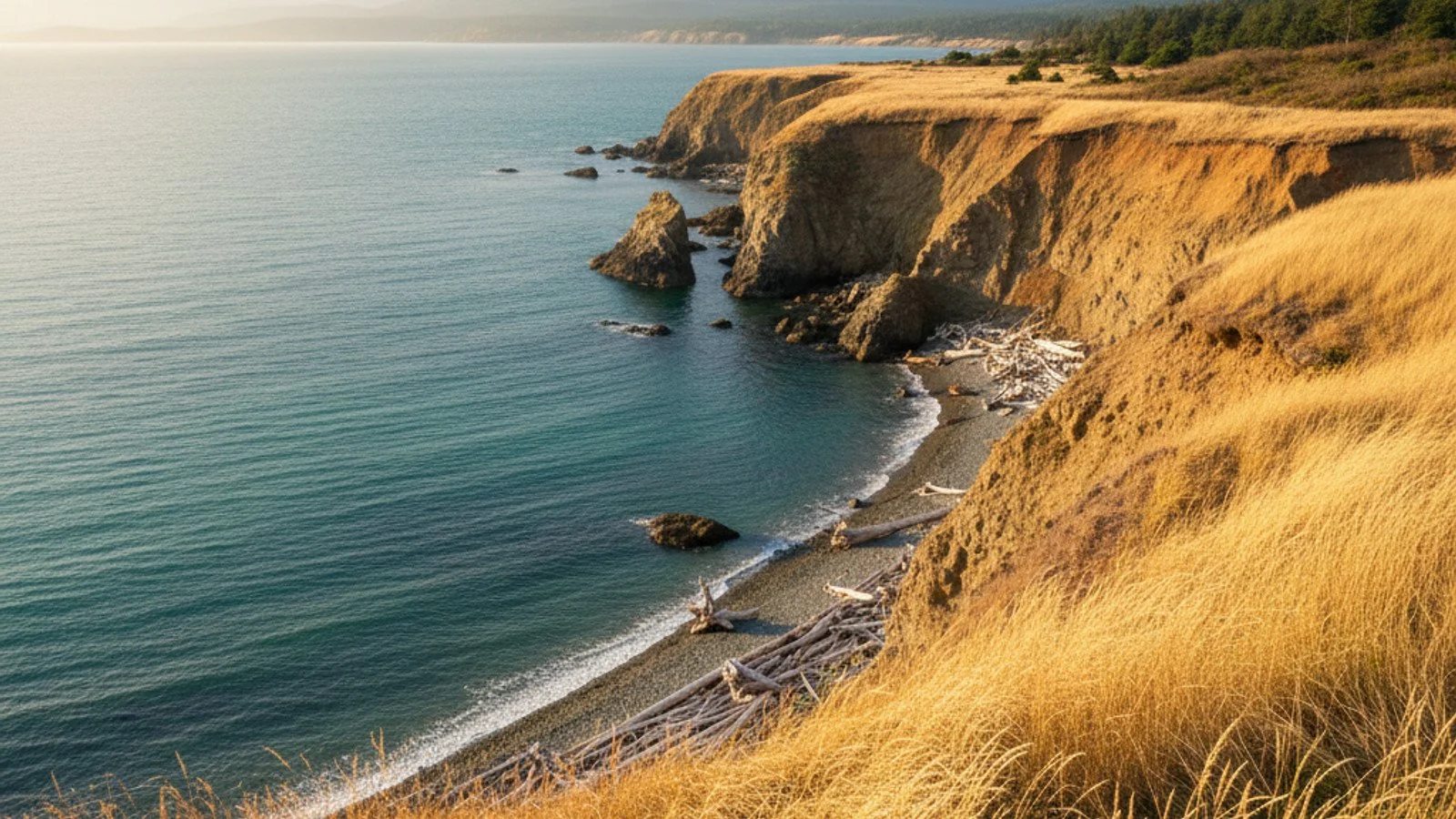
If you have ever driven the length of Whidbey Island, you know it feels like a distinct world separate from the mainland hustle. It is a place where rugged natural beauty meets deep historical roots, creating a landscape that tells a story around every curve of the highway. As the longest island in Washington (stretching roughly 35 to 55 miles, depending on how you measure the coast), its unique, winding shape was carved by ancient glaciers, leaving behind the bluffs and prairies we admire today.
living on Whidbey Island
Located in the heart of Puget Sound and serving as the anchor of Island County, Whidbey is more than just a scenic getaway. Its timeline is rich and complex, moving from the enduring presence of Indigenous peoples to European exploration, pioneer farming, and modern military defense. For anyone thinking about living on Whidbey Island, understanding this history adds a layer of appreciation to every view of the water and every walk through the woods.
The First Inhabitants: Coast Salish Heritage
Long before maps were drawn or ships arrived, Whidbey Island was—and remains—the home of the Coast Salish peoples. It is vital to recognize that the history of this land begins "since time immemorial." The Lower Skagit, Snohomish, Suquamish, and Swinomish tribes thrived here, building a culture deeply intertwined with the rhythms of the Salish Sea.
The island’s geography provided an abundance of resources. The cedar forests offered materials for longhouses and canoes, while the waters provided salmon and shellfish. The famous Penn Cove mussels we enjoy at local restaurants today are part of a food system that has sustained the local population for thousands of years.
This is not just ancient history; the descendants of these tribes are still very much present in the region today, continuing to steward the land and water. The rich cultural heritage of the Coast Salish peoples is the foundation upon which modern Whidbey Island stands.
1792: European Exploration and the Naming of the Island
The European chapter of the island's history kicked off in June 1792 with the arrival of the HMS Discovery. Captain George Vancouver was leading an expedition to map the Pacific Northwest coast. At the time, early explorers (including the Spanish explorer Quimper) weren't entirely sure if the landmass was an island or a peninsula connected to the mainland.
The mystery was solved by Joseph Whidbey, the master of the Discovery. He took a small boat and successfully circumnavigated the landmass, navigating through the treacherous currents of what we now call Deception Pass. By proving that the water cut all the way through, he confirmed it was indeed an island.
In honor of this navigational feat, Captain Vancouver named the land Whidbey Island. It is a name that has stuck for over two centuries, immortalizing the man who first mapped its full coastline.
Pioneer Settlement: The Donation Land Claim Era
By the mid-19th century, settlers began arriving, drawn by reports of the island's unique geography. Unlike much of Western Washington, which was covered in dense, old-growth forest that required backbreaking labor to clear, Whidbey boasted open, fertile prairies. Areas like Ebey’s Prairie were ready for farming almost immediately, making them highly desirable.
The population boom really began with the Donation Land Claim Act of 1850. This law granted large tracts of land to citizens willing to settle and cultivate the Pacific Northwest. One of the most prominent figures of this era was Isaac N. Ebey, who filed a claim in the central part of the island.
This era also saw the founding of Coupeville around 1852, making it one of Washington State’s oldest towns. If you are interested in historic homes in Coupeville, you are looking at some of the most authentic pioneer architecture in the region. During this time, settlers also constructed "blockhouses"—fortified log structures designed for protection during periods of regional conflict. several of which still stand today as reminders of that volatile era.
Connecting the Island: The Mosquito Fleet and Deception Pass Bridge
For decades, if you wanted to get to or from Whidbey Island, you took a boat. Before the highways, the "Mosquito Fleet"—a swarm of steamers and small vessels—was the lifeline of the Puget Sound. These boats buzzed between island communities and mainland hubs like Seattle and Everett, carrying passengers, mail, and produce.
That isolation changed dramatically during the Great Depression. In a massive engineering feat, the Deception Pass Bridge was constructed as a Civilian Conservation Corps (CCC) project. Completed in 1935, the bridge finally linked the north end of Whidbey to Fidalgo Island and the mainland.
The bridge did more than just look spectacular; it opened the floodgates for commerce and tourism. Suddenly, the island was accessible by car, transforming the local economy and making the Whidbey Island commute guide a possibility for those working off-island.
A Legacy of Defense: From Fort Casey to NAS Whidbey
Whidbey Island has long served as a guardian of the Puget Sound. In the late 1890s and early 1900s, the US military constructed the "Triangle of Fire" to protect the entrance to Admiralty Inlet. This defense network included Fort Casey on Whidbey, along with Fort Flagler and Fort Worden on the Olympic Peninsula. While the massive guns of Fort Casey are silent now, the bunkers remain a popular state park.
The military legacy evolved significantly with the onset of World War II. In 1942, the Navy commissioned Naval Air Station (NAS) Whidbey Island just outside of Oak Harbor. The arrival of the base transformed the northern part of the island from a quiet agricultural community into a bustling hub of activity.
Today, the base is a primary economic driver for the island. Many residents are active duty personnel or veterans relocating to NAS Whidbey, keeping the island’s patriotic connection strong and vibrant.
Preserving the Past: Ebey’s Landing National Historical Reserve
One of the reasons Whidbey Island retains its charm is that residents have fought to keep it that way. A prime example is the Ebey’s Landing National Historical Reserve. Established in 1978, it was the first historical reserve of its kind in the United States.
This reserve is unique because it doesn't just preserve a single building; it protects an entire cultural landscape. It encompasses working farms, historic blockhouses, shorelines, and the town of Coupeville itself. The goal is to maintain the rural character and historical integrity of the land while people still live and work there.
For those looking at Central Whidbey real estate, this preservation ensures that the sweeping views of prairies and sea remain largely untouched by sprawling development.
Whidbey Island Today: Living Among History
Today, Whidbey Island offers a rare blend of indigenous heritage, maritime history, and agricultural roots. It is a place where you can watch modern Navy jets soar over 19th-century farmhouses, or hike through ancient forests just minutes from a Victorian-era town center.
The history here isn't locked away in a museum; it is part of the daily lifestyle. Residents picnic at the Fort Casey bunkers, buy produce from century-old farms, and drive across the iconic Deception Pass Bridge every day. If you are interested in joining this community, check out our Whidbey Island community guide to see how the past has shaped a wonderful place to live today.
Frequently Asked Questions
Who is Whidbey Island named after?
The island is named after Joseph Whidbey, the master of the HMS Discovery. He served under Captain George Vancouver and was the first European to circumnavigate the island in 1792, proving it was not a peninsula.
How long has Whidbey Island been inhabited?
Indigenous peoples have inhabited Whidbey Island since time immemorial, thousands of years before European exploration. The Coast Salish tribes, including the Lower Skagit and Snohomish, have a deep, enduring connection to the land and waters of the region.
What is the historical significance of Coupeville?
Founded around 1852, Coupeville is one of the oldest towns in Washington State. It lies within Ebey’s Landing National Historical Reserve and features many original pioneer buildings, making it a central hub for the island's maritime and agricultural history.
When was the Deception Pass Bridge built?
The Deception Pass Bridge was completed in 1935 as a project of the Civilian Conservation Corps (CCC) during the Great Depression. Its opening marked the end of the water-only era and connected Whidbey Island to the mainland by road for the first time.