Weather on Whidbey Island WA: Living in the Olympic Rain Shadow
If I had a dollar for every time a client asked me, "Is it going to rain every single day if I move there?" I could probably retire early. It is the most common misconception about our area. Because we are so close to Seattle, most people assume living on Whidbey Island means signing up for the same constant drizzle that the Emerald City is famous for.
Here is the secret that locals know and love: That assumption is largely false.
While we certainly get our fair share of grey days—this is the Pacific Northwest, after all—Whidbey Island enjoys a unique geographical advantage called the Olympic Rain Shadow. This natural phenomenon shields large parts of the island from the brunt of Pacific storms. However, the weather isn’t uniform across the entire island. Depending on where you choose to settle, you might experience a climate that feels surprisingly Mediterranean or one that is lush and forested.
If you are looking at our Whidbey Island location guide and trying to decide where to buy, understanding these weather patterns is just as important as checking the school district or property taxes.
Understanding the Olympic Rain Shadow
To understand why our weather is different, you have to look west. The Olympic Mountains act as a massive wall protecting us from incoming Pacific weather systems.
Here is the simple version of the physics: Moist air rolls in off the ocean and hits the mountains. As the air is forced up, it cools and dumps the majority of its moisture as rain (or snow) on the coast and the Olympic Peninsula. By the time that air mass clears the peaks and descends over the Puget Sound, it has dried out significantly.
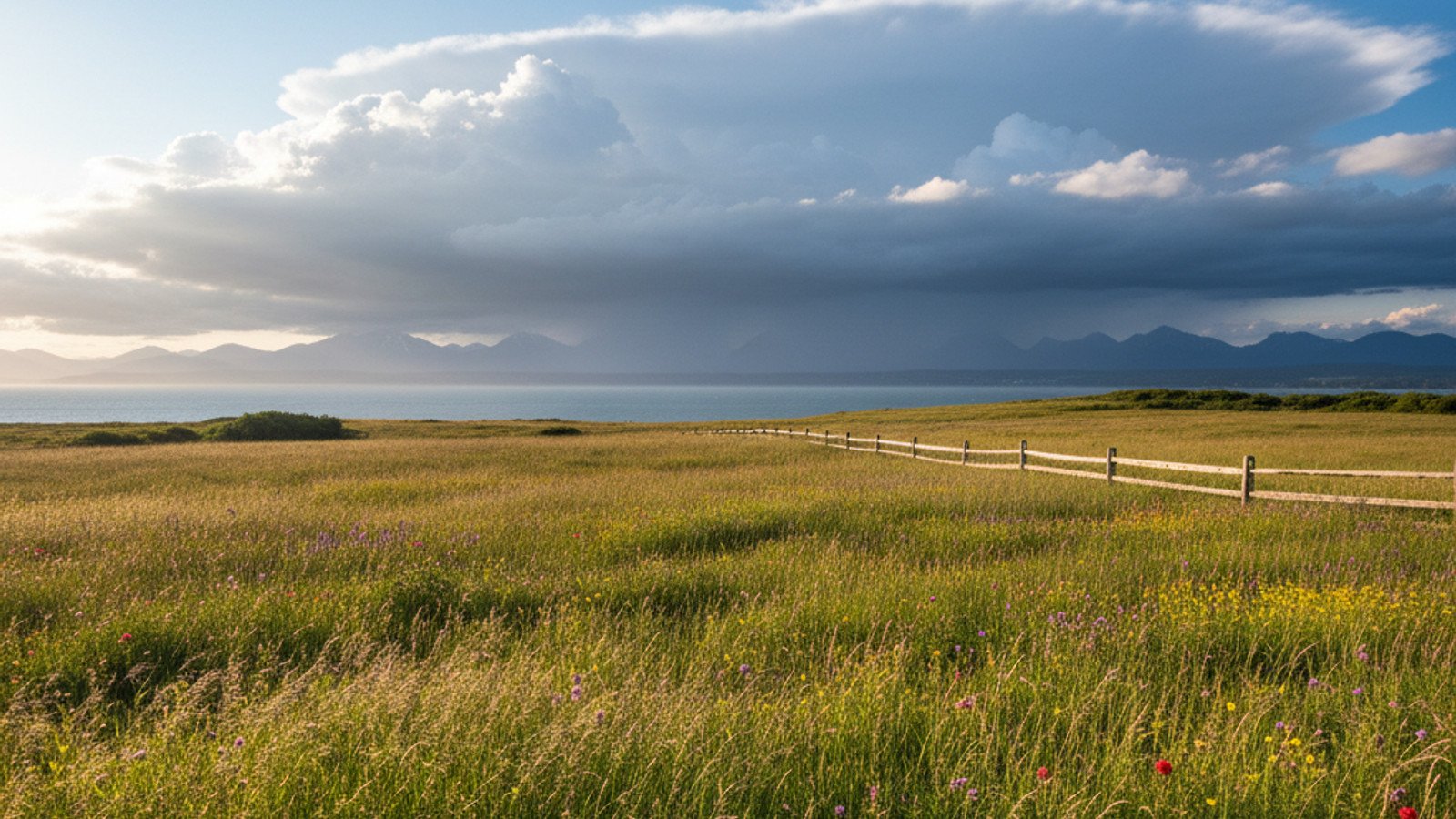
For residents, the visual evidence is striking. It is not uncommon to stand in a sunny backyard in Coupeville, look south toward Seattle or Everett, and see a thick wall of dark clouds raining on the mainland. We often call this the "hole in the sky." This effect is most powerful in the central and northern parts of the island, creating a microclimate that is distinct from the rest of the region.
North vs. South: A Tale of Two Climates
One of the first things I tell buyers is that Whidbey Island is long—about 55 miles—and the weather on one end does not always match the weather on the other.
North Whidbey (Oak Harbor & Coupeville) This area sits deep within the Rain Shadow. The landscape here is more open, with rolling prairies and fewer dense forests. It is significantly drier, often sunnier, and generally windier due to the exposure. This is where Naval Air Station Whidbey Island is located, and the open skies are a defining feature.
South Whidbey (Langley, Clinton & Freeland) As you drive south, you will notice the vegetation gets thicker, taller, and greener. That is because the Rain Shadow effect weakens the further south you go. The south end is closer to the "Puget Sound Convergence Zone," where air currents wrap around the mountains and collide, often bringing rain to the south end while the north remains dry.
Here is a quick breakdown of annual rainfall to show you just how drastic the difference is:
Oak Harbor (North): Approximately 20–22 inches per year
Langley (South): Approximately 29 inches per year
Seattle (Comparison): Approximately 37–39 inches per year
When you look at homes for sale in Oak Harbor, you are looking at an area that receives nearly half the rainfall of Seattle. That is a massive lifestyle difference for retirees or anyone tired of the mud. Conversely, Langley real estate listings offer that classic, lush Pacific Northwest evergreen vibe that many people love, simply because the trees get more water.
Seasonal Weather Guide & Lifestyle Impacts
Living here means living in rhythm with the seasons. We don't have drastic temperature swings, but the character of the island changes every few months.
Spring (March - May)
Spring comes a bit earlier here than on the mainland, especially in the Rain Shadow. By March, the daffodils are up. You will hear locals talk about "sunbreaks"—those glorious moments when the clouds part. This is prime time for gardeners to start prepping beds. The soil dries out faster in Coupeville and Oak Harbor, allowing for an earlier start to the growing season.
Summer (June - September)
This is the "Golden Season." If you visit in August, you will want to move here immediately. High temperatures usually hover in the low-to-mid 70s, humidity is almost non-existent, and rain is very rare. It is the payoff for the grey months. This is when everyone is outside hiking, or exploring the best beaches on Whidbey Island. The days are long, with twilight lasting well past 9:00 PM.
Fall (October - November)
October is often beautiful, with crisp air and changing leaves, but November marks the shift. We often see heavy fog banks rolling in, especially in the valleys and near the water. This is also the start of the wind season. You’ll want to have your gutters cleaned and your yard furniture secured by Halloween.
Winter (December - February)
I won't sugarcoat it: winters are dark. The sun sets as early as 4:15 PM in December. While it doesn't get bitterly cold (average lows are usually in the upper 30s), the dampness can make it feel chillier. This is the season for reading by the fire and storm watching.
Wind, Water, and Warnings: What to Watch Out For
While we don't worry about hurricanes or tornadoes, weather does impact our logistics. If you are moving here, there are three main things to prepare for.
The "November Gales" Wind storms are a reality of island life. From late autumn through winter, we can get gusts topping 40 or 50 mph. Because we have so many tall trees, power outages happen. Most long-time residents have a generator or a wood stove as a backup. It’s just part of the rural charm.
Ferry Cancellations If you plan to commute, you need to check the Whidbey Island ferry guide regularly. The weather impacts the two ferry routes differently:
Coupeville to Port Townsend: This route crosses a very turbulent section of water. It is frequently cancelled due to high winds or extreme tides.
Clinton to Mukilteo: This run is much more protected and robust. It rarely cancels for weather, though it can happen in severe storms.
The Convergence Zone This is a local weather band that can form suddenly. You might be driving north from Clinton in pouring rain and hail, and by the time you hit Greenbank, the roads are dry and the sun is out. It’s a fascinating, if sometimes frustrating, feature of South Whidbey living.
Does it Snow on Whidbey Island?
This is a top question for relocators coming from the Midwest or East Coast. The short answer is: rarely, and it doesn't last long.
We typically see snow once or twice a year, usually in December or January. Accumulation is generally light—maybe 2 to 4 inches. Because we are surrounded by saltwater, the marine air usually turns that snow to slush or rain within 24 to 48 hours.
However, even a little snow causes chaos here. Our roads are hilly, winding, and often unlit. We don't have the fleet of snowplows that a city like Chicago has. Schools will delay or close for even an inch of slush because buses simply can't navigate the hills safely. Interestingly, the North end often gets slightly more snow accumulation because it lacks the heavy tree canopy cover found in the South.
Frequently Asked Questions
What is the best month to visit Whidbey Island for weather?
Statistically, July, August, and September are the best months. You can expect highs in the 70s, very little rain, and clear views of the Olympic and Cascade mountains. It is the ideal time for outdoor activities and house hunting.
Is Whidbey Island colder than Seattle?
Technically, it can be a degree or two cooler, but the real difference is the wind. Because we are exposed to the Strait of Juan de Fuca, the marine breeze can make it feel brisk even on sunny days. You will almost always want a light layer or windbreaker handy.
Do I need air conditioning on Whidbey Island?
Historically, most homes here did not have AC. However, as summers have trended warmer with occasional heat spikes into the 80s or 90s, air conditioning (specifically heat pumps) has become a very popular upgrade for comfort during those few hot weeks.
Does the ferry stop running when it's windy?
Yes, wind is the primary reason for cancellations. The Coupeville-Port Townsend route is very sensitive to wind conditions and cancels often in the winter. The Clinton-Mukilteo route is much more reliable but can still be suspended during severe gale warnings.